Founder Pricing Is an Honor System
A price the buyer picks by naming who they are is a suggestion. Three questions to run on your own pricing page, and what to charge instead.
For two months, my pricing page asked every buyer one question.
Are you a founder or a CMO?
Founders paid $497. CMOs paid $997. Same diagnosis, same hand scoring it. The CMO side promised one extra page, a CFO one-pager. A little pill-shaped toggle sat above the price, and you clicked whichever side described you.
Nothing checked the answer.
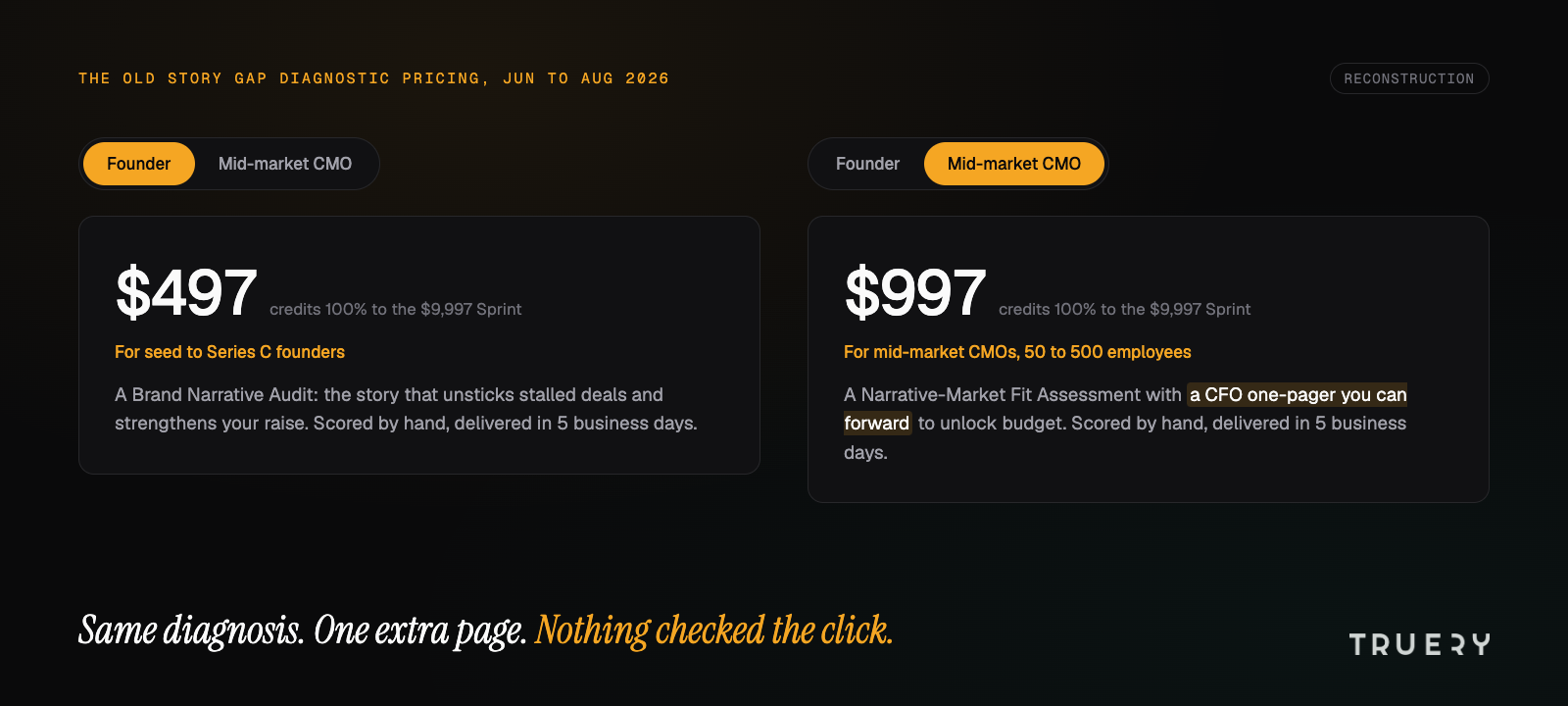
The toggle had no lock
I sell a product called the Story Gap Diagnostic. I score a brand's story by hand and hand back a plan. For a while it came in two prices, sorted by job title.
It felt generous. Founders spend their own money. CMOs have budgets. Charge each what they can carry. Lots of founders run some version of this. A startup tier, founder pricing, a small-business rate.
Looking back, I'd put it plainly. It was a faulty mechanism from the beginning. No verification. And an unfair precedent for founders versus CMOs.
Two failures, both baked in on day one.
Failure one: a label is a claim
A buyer who reads your page closely sees two prices for the same thing. The lower one asks a question with no follow-up.
Nothing stopped a CMO from clicking Founder. No form, no check, no proof of anything.
So who pays the higher price? The honest buyer, and the one who didn't look closely. You've built a discount that rewards whoever reads carefully and taxes everyone else.
If the cheaper price is one click away, the cheaper price is your price. You just haven't admitted it yet.
Failure two: same work, different money
Say every buyer clicks honestly. The mechanism still breaks.
Two people get nearly identical work. One pays twice what the other pays. On my page the difference came down to one extra page and a title.
That sets a precedent. The buyer who paid $997 learns the price was a mood. The buyer who paid $497 learns your price bends if you describe yourself the right way. Both lessons walk into the next conversation with you, the one about the bigger engagement.
A title is not a deliverable. You can't point at it.
The Toggle Test
Run these three questions against every tier and discount on your pricing page.
1. The Click Question
Can a buyer get this price just by choosing it, with nothing checked?
2. The Same-Work Question
Does a buyer at this price get identical work to a buyer at a different price?
3. The Point-At-It Question
What specific deliverable explains the difference?
A yes on either of the first two, or a blank on the third, and that tier is a suggestion. My toggle failed the first one outright. The other two came down to a single extra page, which is a thin answer for $500.
Three ways to charge different buyers differently
You can charge different buyers different amounts and still defend every number. I'd stand behind three ways.
One deliverable, one price. If the work is the same, the price is the same. This is the one I chose.
Different work, different price. The cheaper tier has to be missing something real, and you have to name it. Fewer deliverables. Less of your time. No competitor benchmarks. Something the buyer can see.
A discount you actually verify. Want to give early-stage companies a break? Check the stage. A discount you verify is a policy. A discount you don't is a suggestion.
What I charge now
The Story Gap Diagnostic is $997. For everyone.
That price covers all of it. Your Story Gap Score from 0 to 10 across five dimensions. Your Enemy, named. The Swap Test run on your own copy. What the gap costs you in dollars. A 90-day fix plan in priority order. Three competitors scored against you. A CFO one-pager and a board-ready summary. And a 15-minute recorded walkthrough from me.
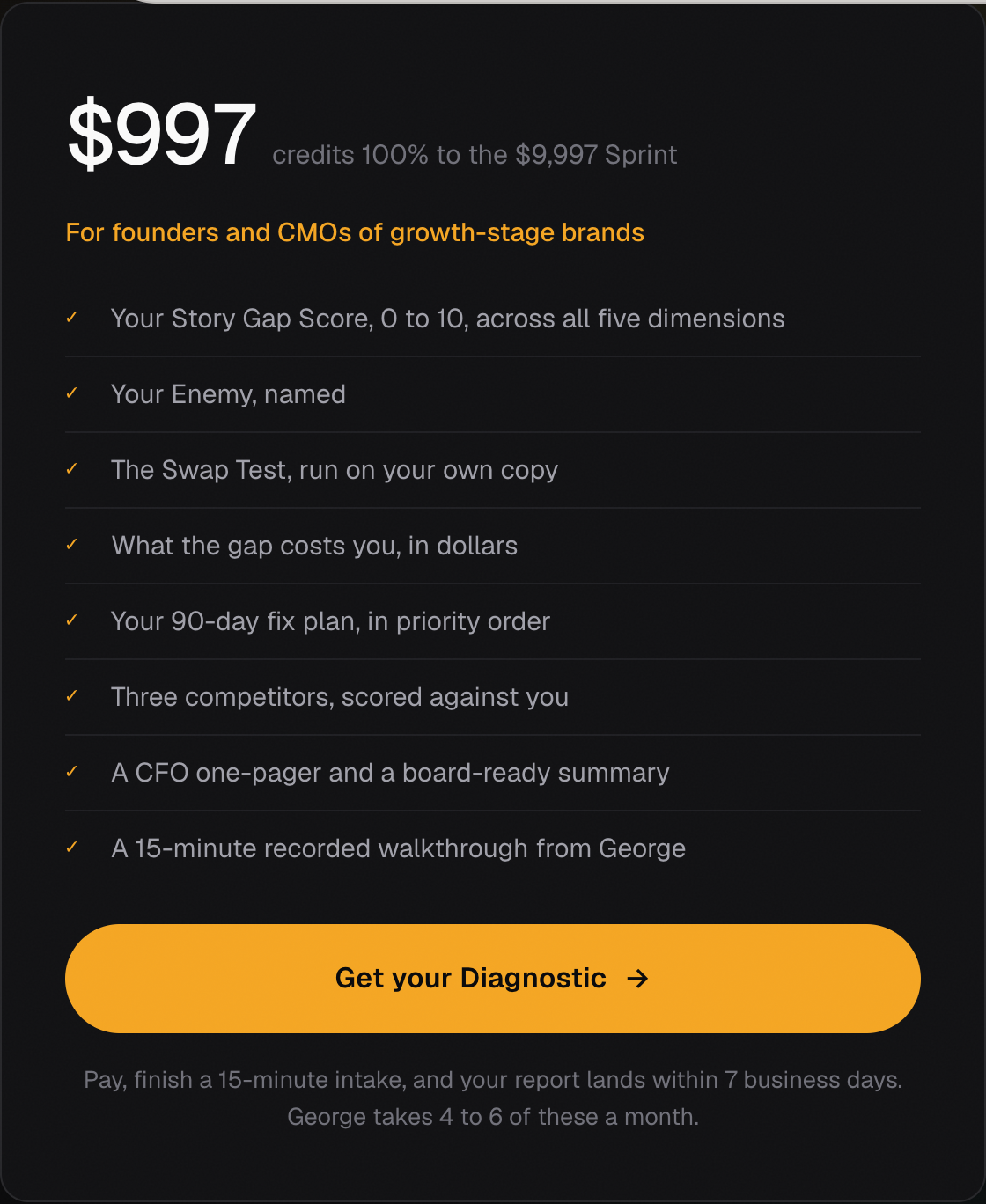
The pricing section got simpler the day the toggle came out. One card, one list. The page stopped sorting people and started describing the work.
If a smaller company balks at $997, I'd rather solve that with terms than with a label. The full $997 credits toward the $9,997 Brand Story Sprint if you start within 30 days of delivery. The risk sits on the next decision, where it belongs.
The opposite of an honor system
The toggle asked the buyer to make a claim nobody checked. The fix runs the other way. I make a claim the buyer can hold me to.
If your Diagnostic score comes back 8 or higher, I'll tell you the Sprint would be a waste of your money. It's published on the page, and I say it in the walkthrough.
Honest pricing and honest selling are the same muscle. You decide something real, out loud, and let the buyer check it.
Run it on your own page
Paste your pricing page into any AI assistant with this, or just answer it yourself.
Here is my pricing page. For every tier or discount on it, answer three questions:
1. The Click Question: can a buyer get this price just by choosing it, with nothing checked?
2. The Same-Work Question: does a buyer at this price get identical work to a buyer at a different price?
3. The Point-At-It Question: what specific deliverable explains the price difference?
Flag any tier where question 1 is "yes," question 2 is "yes," or question 3 has no concrete answer.
For each flagged tier, recommend one fix: merge into one price, make the cheaper tier genuinely
different work, or add a real verification step.
Your pricing page is part of your story
Buyers read your pricing page the way they read your homepage. They're looking for what you actually believe.
A toggle sorted by title tells them your price is a guess. One price with everything listed under it tells them you know what the work is worth.
If you want to see what the rest of your pages are telling buyers, start with the free Story Gap Scorecard at truery.com/scorecard. It scores your story across the same five dimensions the Diagnostic uses.
Here's to your next story,
George V.K.
FAQ
Is founder pricing always a mistake?
No. A verified discount is a policy you chose. The problem is an unverified label. If a buyer can claim the lower price by clicking, the lower price belongs to everyone who reads your page closely.
How do I charge different customers different prices fairly?
Make the work different. The cheaper tier has to lack something you can name, like fewer deliverables, less of your time, or no benchmarks. If the work is identical, charge one price.
Won't one higher price lose smaller buyers?
Some, maybe. I'd reach for terms before discounts. The Story Gap Diagnostic is $997 for everyone and credits the full amount toward the $9,997 Brand Story Sprint if the buyer moves forward within 30 days of delivery.
What does the Story Gap Diagnostic include for $997?
Everything, for everyone. A Story Gap Score from 0 to 10 across five dimensions, with your Enemy named and the Swap Test run on your own copy. The cost of the gap in dollars and a 90-day fix plan. Three competitors scored against you, plus a CFO one-pager and board-ready summary. A 15-minute recorded walkthrough from George V.K. The report lands within 7 business days of intake.
What is the anti-sell rule?
If your Diagnostic score comes back 8 or higher, George tells you the Brand Story Sprint would be a waste of your money. The diagnosis is credible because it can come back "don't buy."