Can Your Homepage Say What You Do in 2 Seconds?
My homepage said "A resort, a product, a founder." I sell the one true story. What the research said buyers check, and how I took my own medicine.
DJ Maestro couldn't say what they did for their customers. We sat down for four hours of interviews, and it came down to a few very simple sentences.
Meanwhile my own homepage said: "A resort, a product, a founder."
A cobbler with no shoes. I sell the one true story, and my front door listed three things and committed to none of them.
Short answer: most can't. Buyers check for clarity and honest proof, and award juries score design. I rebuilt truery.com around one six-word line, put the film first, cut every public price, and took mobile Lighthouse from 45 to 61 up to 95 to 96. Here is the research, the test, and what I'd steal for your homepage.
Four hours to a few simple sentences
The DJ Maestro job was a brand anthem. Before a camera rolled, I interviewed the founder and a few people on the team. Four hours. They knew their work cold. They had a hard time saying, in plain words, what they actually did for their customers.
That's normal. The closer you are to a company, the more true things you can say about it, and the harder it gets to pick one. The job is digging until the one story only you can tell comes up. We call that phase Story Excavation. It is step one of the Story Architecture System.
Tony London, their Founder and CEO, put the result better than I can:
"As a company, we've always struggled to clearly express to our clients what makes us unique... Thanks to George, we now have a powerful tool that... finally articulates who we are as a company in a real and authentic way."
Tony London, Founder & CEO, DJ Maestro
Then I'd go home and look at my own site.
My homepage listed three things and meant none
"A resort, a product, a founder." I wrote it because I couldn't commit to one niche. Hotels, products and founders are all real work for me. None of it told a stranger why to pick me.
The page under that line ran about 34,000 pixels tall on desktop. The first film sat below two calls to action and the pricing. I run a film company, and visitors had to read for a long time before they could feel anything.
The fix on positioning came first. Niche on who I am as a storyteller and on the size of company I serve, mid-size and Fortune 500 companies. Range across industries stays. The story is the specialty.
So I did what I'd do for a client. Research before opinions.
Award-winning sites and client-winning sites are mostly different sites
The question was simple. Which creative video agency websites are stunning, fast and award-worthy, and also bring in high-paying clients?
The famous studios (Buck, Psyop, Giant Ant, Oddfellows and others) have beautiful sites. Our research turned up no verifiable website award for any of them from 2022 to 2026. They don't need one. Their buyers arrive pre-sold, so their sites only have to show work.
The verified winners were smaller production shops and WebGL studios. 1820 Productions took an Awwwards Site of the Day in February 2026 with an overall 7.34. Immersive Garden and Lusion score higher on the 3D side. And on the heavy WebGL winners, usability was the lowest sub-score. Immersive Garden paired 8.8 for animations with 6.6 for accessibility.
Look at what the jury weights and it makes sense:
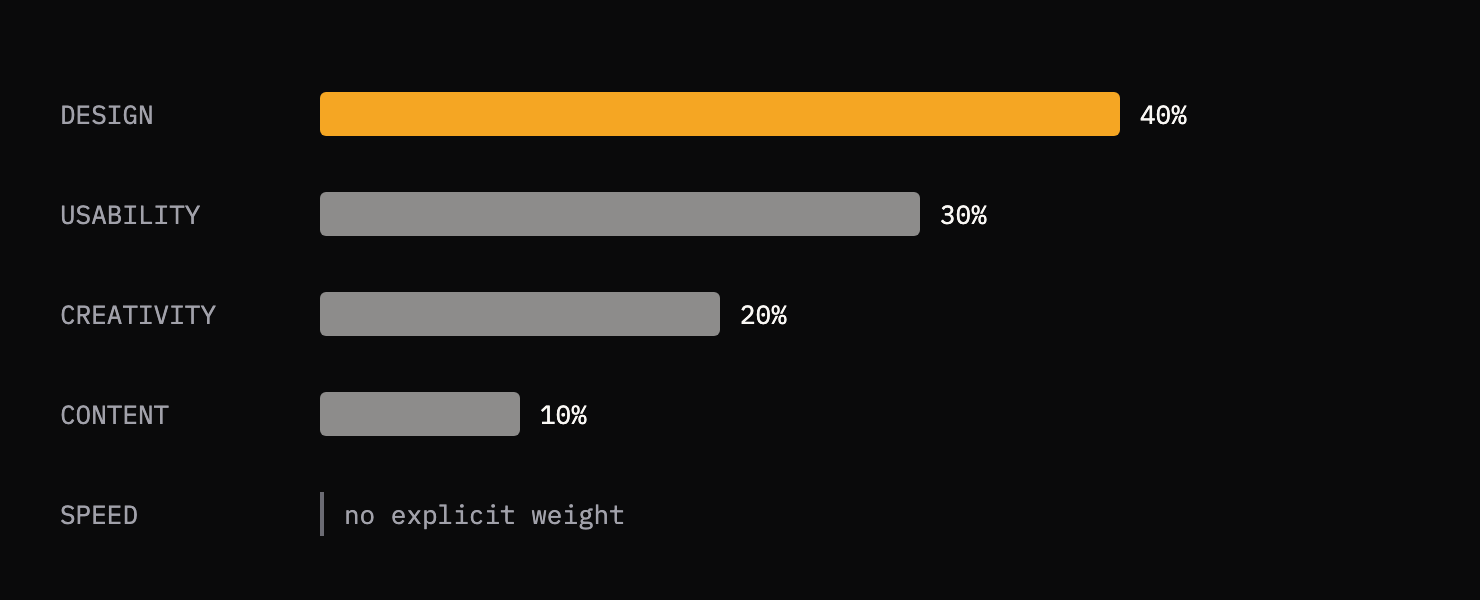
Awards measure the wrong thing. They measure the wrapper. Buyers check something else.
What buyers say they check
The only recurring survey that asks clients about agency websites is What Clients Think (680 clients in 2025, weighted toward the UK, and run by a firm that sells new-business consulting to agencies, so read it with that in mind). Its numbers:
- 61% can't identify an agency's expertise from its website.
- 68% are unimpressed by showreels that lack context.
- 66% say case studies don't tell them the business problem.
- 79% want agencies to state the type of client they want.
- 77% expect creative to show clear ROI, up from 59% in 2023.
And the site matters more than referrals suggest. In RSW/US data, discovery through networking fell from 73% in 2022 to 58% in 2025. RSW/US sells outbound, so it likes that finding. Even so, a referred CMO still opens your homepage to check you. That check takes minutes, and it's mostly about clarity and proof.
Clarity first, then.
The headline test: three questions, four lines
Every candidate headline had to pass three tests.
- Two seconds. Does "film" register in the first two seconds? A visitor should know we make films before they read anything else.
- Logo swap. Put a competitor's logo on the line. If it still fits, it describes the whole category. Rewrite.
- Contestable. Could a smart person disagree with it? If nobody could, it says nothing.
| Line | Verdict |
|---|---|
| A. "Every brand has one true story. We find it. Then we film it." | Right content. 11 words, four to five lines at display size, template cadence. |
| B. "Let them feel it before they buy." | The best line. No film signal. "Them" and "it" point at nothing, so it reads like a perfume ad. |
| C. "Film stories people feel." | Fails the Logo Swap Test outright. A big studio or a wedding videographer could run it tomorrow. |
| D. "Your one true story, on film." | Six words. Film lands in two seconds. "One true" echoes TRUERY. "One" is a claim someone can argue with. |
D won. B moved down the page and became the thesis section: "Let them feel it before they buy." The sub-line under the headline does the explaining: we dig out the story only your company can tell, then make the film that lets people feel it before they buy.
A showreel without context is wallpaper
That 68% number changed how the work section reads. A reel with no context is pretty and silent. So every film tile now carries one line naming the story we found for that client.
What it doesn't carry is an outcome number. The partner films I was shooting this fall weren't finished, so there were no results to report. I could have written something that sounded like a metric. A client would have seen through it, and they'd be right to.
Honest proof is slower. It's also the only kind that holds up when a buyer calls the client.
One real quote beats three weak ones
I went through every review I had. Most were short, or signed with a first name. One had a full name, a title and a company, and it said exactly what the page argues. That's Tony London's. It's the only quote on the homepage, and it gets the room to breathe.
No prices, anywhere
Prices came off every public page on the site. An automated test now fails the build if one comes back.
My reason, in the words I gave when we made the call: "A published price becomes the market price."
I'll be straight about the evidence. It's thin in both directions. In our sample, no studio at the top of the market published prices. Some productized studios do publish packages and still win big clients. This is a position, and I'm taking it.
The same logic hit the brief form. A budget dropdown with ranges is pricing by another name. It's gone. The form asks one thing instead: is budget set aside? Approved, planning, or not yet.
Film first
Two section orders lost.
The pure portfolio, four sections and a contact link, works when your client list is a row of household names. Mine needs the method and the person on the page.
Thesis-first, belief before proof, was the old site's exact mistake.
What shipped is film-first: Hero, Work, Method ("How we find it."), Thesis ("Let them feel it before they buy."), Track record, George, Start a film.
The hero loop took a correction too. The first loop on the table was all drone aerials. In my own study of hotel films, generic drone aerials were the top cliché, in 19 of 22 films. A wall of aerials on a site that sells "the one story only you can tell" would have argued against itself. The hero became the opening eight seconds of my 2026 reel instead: people, range, craft.
Bytes don't predict speed
Here's the number that surprised me. The old truery.com weighed about 1 MB. Light. It scored 45 to 61 on mobile Lighthouse.
A studio site that weighed 71 MB scored 81.
The heavy site painted its first video frame fast and kept the main thread quiet. My light site hid its headline behind a JavaScript reveal, so the browser had nothing big to paint until the script ran. The score follows what paints first and how hard the main thread works.
| Site | Mobile score | Note |
|---|---|---|
| Vidico | 91 | The only video-production site in the sample at 90+ |
| Tendril | 81 | 71 MB page, fast first frame |
| Golden Wolf | 75 | |
| Psyop | 72 | |
| Buck | 56 | |
| Sandwich | 56 | |
| Demo Duck | 56 | |
| Umault | 40 | 39 MB, 29 s largest paint on mobile |
| truery.com (before) | 45 to 61 | About 1 MB, headline revealed by JavaScript |
Lighthouse mobile, lab only, single runs on 2026-10-09, about plus or minus 10 points per run. No field data. Treat it as a snapshot.
Does speed matter for a site like this? Directionally, yes. In Google and Deloitte's data, a 0.1 second mobile improvement went with 21.6% more lead-gen form submissions. Portent found 1 second pages converting about 3x better than 5 second pages. Both studies are correlational and predate Core Web Vitals. Treat them as direction.
The fix ladder
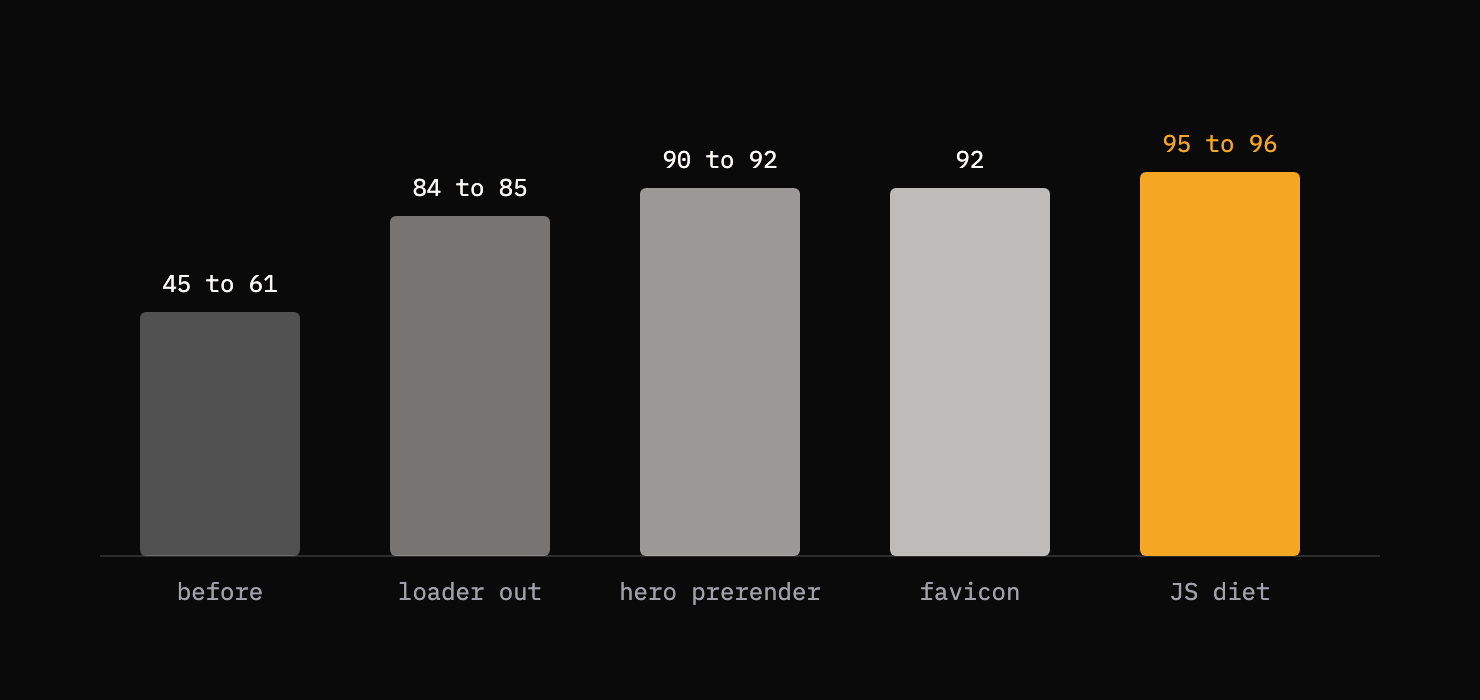
- Drop the logo loader. A first-visit logo animation plus a fade-in from invisible meant Lighthouse couldn't find a largest paint at all. Score: 0. Removing it gave 84 to 85.
- Prerender the hero. The headline and hero now arrive as plain HTML, and the app takes over in the same frame with no layout shift. 90 to 92.
- Shrink the favicon. The old one was a 36 KB copy of a 1024 pixel image. Now it's 7.4 KB. 92 across three runs.
- Move two animation libraries off the startup path. Startup JavaScript went from about 203 KB to 112 KB gzip. First paint went from 2.3 to 1.7 seconds, and lab LCP went to 2.6 seconds. 95 to 96.
For the record, 2.6 seconds is a tenth over web.dev's 2.5 second "good" line. Close. Not done.
What the reviews caught
Every batch of the build went through two reviews, one against the spec and one for code quality. They caught real problems before a visitor ever could:
- Small labels failed AA contrast at 4.33:1. Fixed to 5.15:1.
- An unusually long name could overflow the notification I get for each brief and lose it silently.
- One form check took 5.8 seconds to process 26 characters.
- The nav was invisible on the About page. Cream on cream.
- A second click on "Start a film" didn't scroll anywhere.
The build now runs 575 tests and a launch check that refuses to deploy while any real-content slot is empty: story lines, the quote, the portrait, the hero. No placeholders ever reach the page.
I built it with Claude as an AI pair. Every batch went through those two reviews before anything shipped.
The honest limit
Traffic to truery.com is low. At that volume, no change I make to the page will show up as a measurable conversion lift, so I'm claiming none.
The site's job is narrower. Most people who land on it already heard my name from a referral, an email or a partner. The homepage is a window display. Its one job is to make the right buyer walk through the front door.
Judge it on that.
Steal this: run the test on your own homepage
THE THREE-QUESTION HEADLINE TEST (10 minutes)

1. Two seconds. Show your homepage's first screen to someone
   outside the company for two seconds. Close it. Ask: what do
   we sell? If they can't say it, your headline is hiding your
   category.

2. Logo swap. Paste your top competitor's logo over yours.
   Read the headline again. If it still fits, it describes the
   whole category. Rewrite until only your logo fits.

3. Contestable. Could a smart competitor disagree with it?
   If nobody could, it says nothing.

4. Proof check. Under every case study, write one line: the
   problem or the story you found. No measured result yet?
   Name the story. Never invent the number.

5. Paint check. Run a mobile Lighthouse test. If your headline
   or hero animates in from invisible, render it visible first
   and animate after.
FAQ
What makes a video agency website win clients?
Clarity and honest proof. In What Clients Think 2025 (680 clients, UK-weighted, vendor-run), 61% couldn't identify an agency's expertise from its site, 68% were unimpressed by showreels without context, and 79% wanted agencies to say which clients they want. Say what you do in one line, show film with context, and name real clients.
Do website awards help an agency win clients?
Not directly. Awwwards weights Design 40%, Usability 30%, Creativity 20% and Content 10%, with no explicit weight for speed. No buyer survey in our research ranked site awards as a reason to hire, and the best-known studios in our sample showed no verifiable site award from 2022 to 2026.
Should an agency publish prices on its website?
We don't. A published price becomes the market price. The evidence is thin both ways: no top-tier studio in our sample published prices, and some productized studios publish packages and still win large clients.
Does a heavier page always load slower?
No. In a single-run lab sample, a 71 MB studio site scored 81 on mobile Lighthouse because its first frame painted fast. Our 1 MB page scored 45 to 61 because its headline waited on JavaScript.
How fast is the new truery.com?
Mobile Lighthouse 95 to 96 in the lab, up from 45 to 61. Lab LCP is 2.6 seconds, a tenth over web.dev's 2.5 second "good" line. Startup JavaScript dropped from about 203 KB to 112 KB gzip.
What is the Logo Swap Test?
Put a competitor's logo on your headline. If it still works, the line describes the whole category. Rewrite until only your logo fits.
What happens when I start a film on truery.com?
You answer a short brief about what the film is for. George replies within two business days with a first read on your story.
George V.K. is the Brand Story Architect at TRUERY, with 15+ years in video production, 237+ brand stories and a Telly Award for cinematography.
Here's to your next story,
George V.K.