Brand Storytelling: The Framework for 2026
How the neurochemical formula behind story structure creates profit. A practitioner's guide to building brand narratives that change behavior.
I was mindlessly scrolling Instagram when a carousel stopped me cold.
Not an ad. Not a meme. A portrait. A woman looking up, golden circular light streaks coming from within her face. Green teal shadows meeting hot fiery warm highlights.
The headline: "The Hero's Journey Isn't a Storytelling Technique. It's a Neurochemical Formula."
That carousel was by Patrick Moreau of Muse Storytelling. And it laid out something I'd felt for years but never had words for.
Story structure isn't arbitrary. It maps to how your brain produces chemicals. Neuroscientist Paul Zak proved it in a lab.
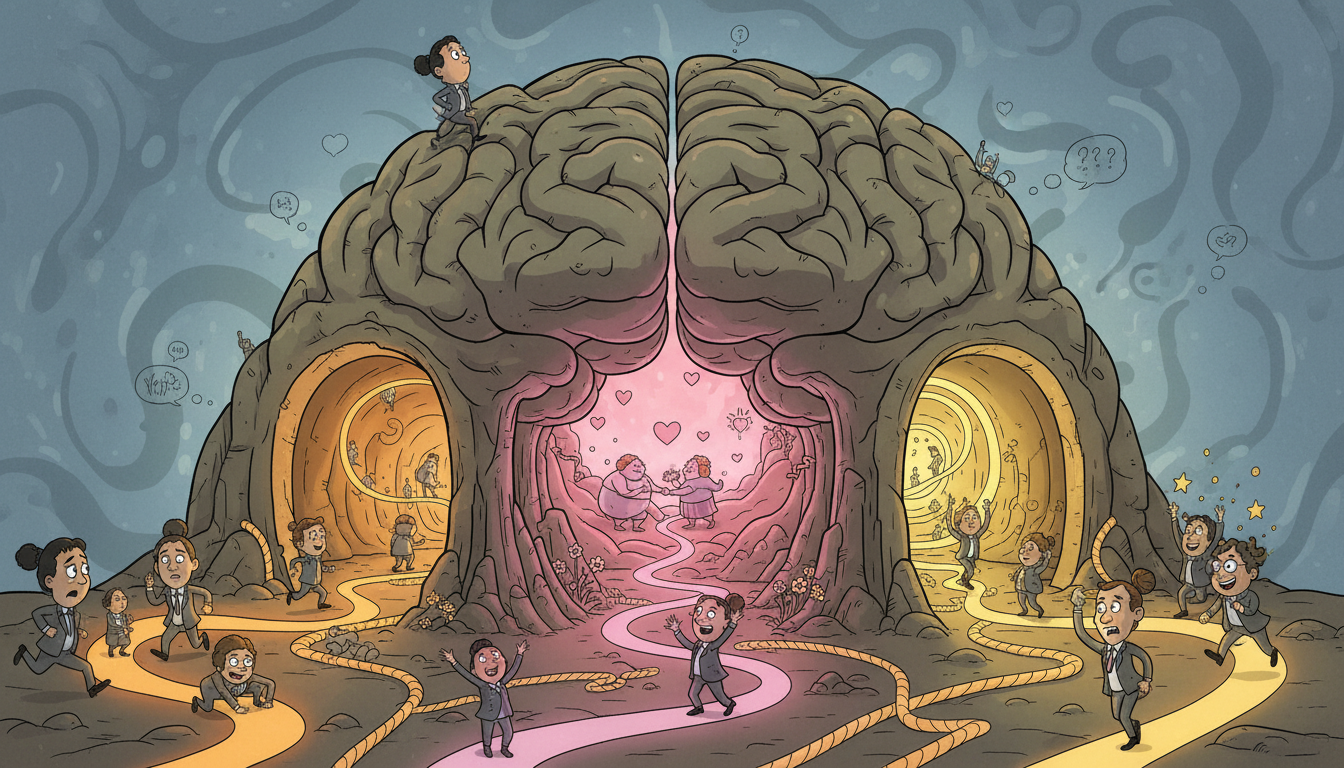
The setup releases cortisol. That's the stress hormone. It creates attention. No tension, no chemical investment. You can't skip to the payoff.
The conflict triggers oxytocin. That's the empathy molecule. But it requires a human subject. Tension without character is anxiety. Tension with character is engagement.
The resolution delivers dopamine. The reward chemical. Not everything works out. But it meant something.
Here's what really got me. After experiencing chemically optimal stories, Zak found that people literally gave more money to strangers. Story changed their behavior. Not just their feelings.
That's the single most important thing anyone in brand storytelling needs to understand in 2026.
Features turn into feelings. Feelings change behavior. Changed behavior creates profit.
What Brand Storytelling Actually Is
Brand storytelling is using narrative to communicate what your brand stands for. Who it changes. And why it matters. It creates emotional connections that feature lists and spec sheets never will.
But here's where most definitions stop. And here's where most brands stay stuck.
Content marketing distributes information. Brand storytelling architects meaning. One teaches. The other changes people. Both matter. But if you're only doing the first, you're building a library when you need a cathedral.
Brand Storytelling vs. Content Marketing
Content marketing asks: "What information does our audience need?"
Brand storytelling asks: "What do our audiences feel when they encounter us?"
The difference is neurochemical. Moreau calls generic content a "flat structure." No stakes. No character arc. No emotional payoff. Forgettable by design.
A brand narrative built on the chemical arc creates tension, empathy, and meaning. That's what sticks. That's what moves people to act.
Why It Matters More Now Than Ever
AI can generate a 2,000-word blog post about brand storytelling in 30 seconds. ChatGPT, Perplexity, and Google AI Overviews answer informational queries before anyone clicks a link.
The generic brand storytelling article? The kind that defines terms, lists examples, ends with a CTA? That's a commodity now.
So what's the moat?
Human perspective.
The ability to take old information and birth a new idea. A new way to look at things nobody has considered before. It's the combination of seemingly incongruent, completely opposite elements into something cohesive and beautiful.
AI can write about trust. It can't build trust.
AI can describe compatibility. It can't be compatible.
Every brand now has access to the same AI-generated content. The ones that win will carry the weight of actual human experience.
The data backs this up. Wyzowl's 2026 State of Video survey found 82% of marketers report positive ROI from video. Edelman's 2025 Trust Barometer showed 88% of consumers say trust is a deciding factor in purchase decisions. Stanford research shows stories are 12x more memorable than facts alone.
But memorability isn't the goal. Behavioral change is.
Zak's research proved that story changes what people do. Not just what they feel. When you understand that distinction, everything shifts. The metrics you chase. The content you create. The results you get.
The Story Gap: Why Most Brand Stories Fail
Most brands don't have a story problem. They have a clarity problem.
I've worked with hundreds of brands. The pattern is always the same. They know their story exists. They feel it in their gut. But they can't extract it themselves.
One client described it as "overwhelming and intimidating." He didn't know where to begin.
So they default to what's easy. Features. Specifications. Awards. "We're the best in town." "Industry-leading solutions." Every competitor says the exact same thing.
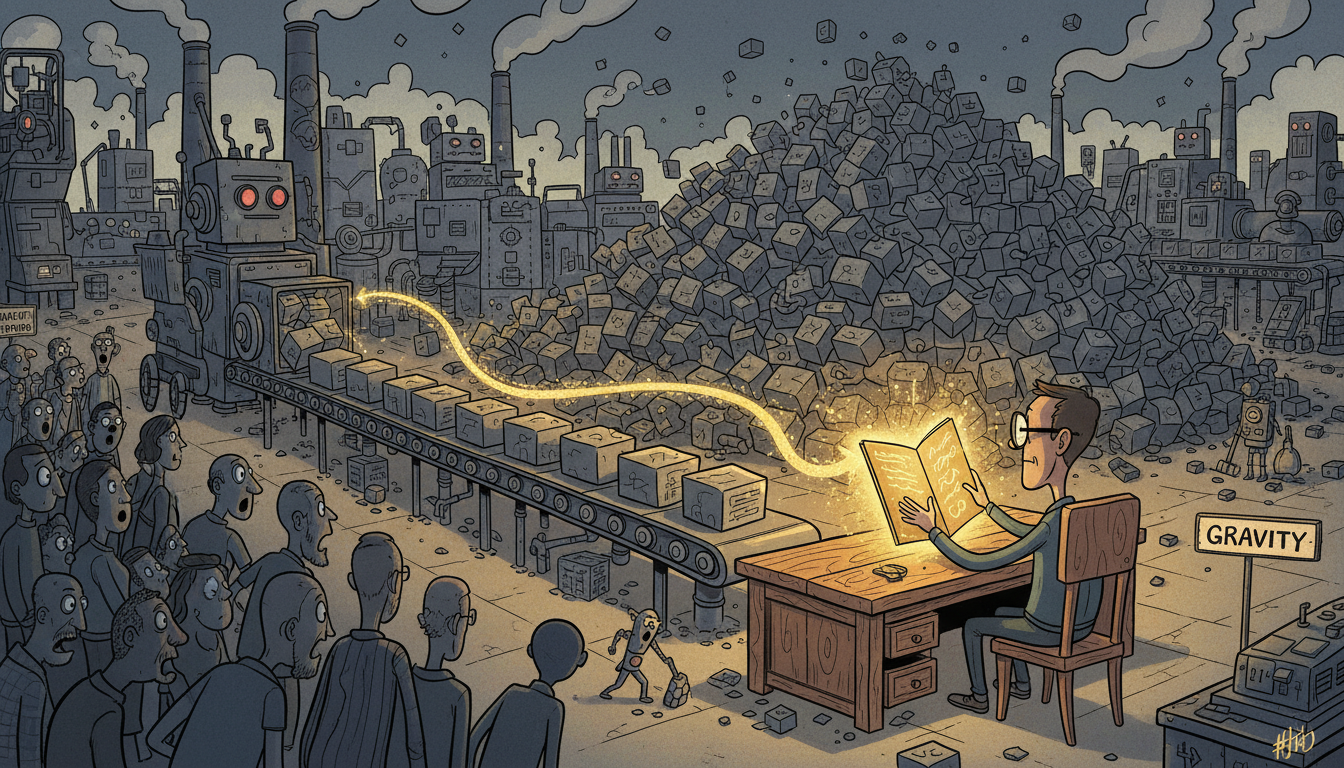
I call this the story gap. It's the distance between the authentic narrative buried inside a brand and the generic messaging they put into the world.
Five Dimensions of the Story Gap
At TRUERY, we measure story gaps across five dimensions. We call it the Story Gap Score.
1. Narrative Clarity. Can a stranger understand your value in 30 seconds? Pull up your homepage. If a visitor can't immediately get what you do and why it matters, you're leaking leads before they scroll.
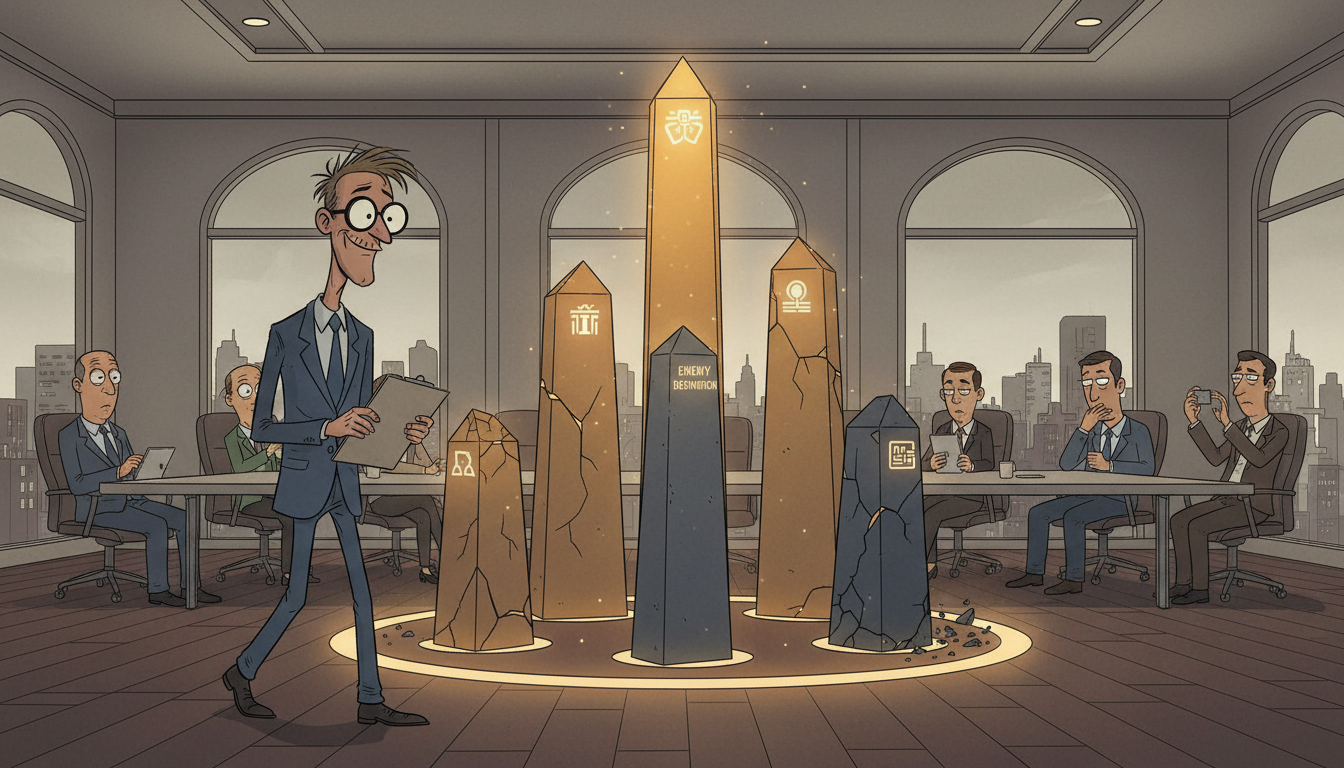
2. Enemy Definition. Does your messaging name what you're fighting against? The best brand stories have a clear villain. Not a competitor. A force. The status quo. The outdated way. Without an enemy, there's no tension. Without tension, there's no cortisol. Without cortisol, there's no attention.
3. Emotional Resonance. Does your content make people feel something? Or just know something? Information creates awareness. Emotion creates movement. Big difference.
4. Competitive Differentiation. Swap your company name with a competitor's in your messaging. If it still works, you don't have a brand story. You have a brochure.
5. Distribution Saturation. Is your story consistent everywhere buyers look? LinkedIn, YouTube, your website, your email sequences. A great brand story that only lives on your About page is wasted potential.
Most companies score between 4 and 6. They're not failing. They're underperforming. And they don't even know it.
The Vanity Metrics Trap
Here's the misconception I see most.
CMOs and VPs of Marketing chasing views. Likes. Top-of-funnel exposure. They think mass awareness will bring them customers.
It won't.
Work backwards. First principles. To convert, a prospect needs to be problem-aware, solution-aware, and product-aware. They just need a push. But to get there, they need to be actively evaluating solutions. And to be evaluating, they need to be aware of the problem.
Every stage requires different content.
But here's the trap. A lot of views does not equal quality leads. The wrong attention is worse than no attention at all. It creates the illusion of progress.
A million views from people who'll never buy costs more than 10,000 views from people actively looking for what you sell.
How to Measure Brand Storytelling ROI
Stop measuring views. Measure these instead:
- Engagement depth. Watch time. Scroll depth. Return visits. Are people consuming the full story?
- Conversion velocity. How fast do engaged audiences move from awareness to decision?
- Sales enablement. Do your reps use the brand story in conversations? Does it shorten the close cycle?
- Inbound quality. Are leads coming in pre-qualified by the story? Do they already get what you stand for?
- Earned authority. Are you being cited and referenced? Not just seen. Trusted.
That's the difference between brands building compounding narrative assets and brands creating disposable content.
DJ Maestro: Story Excavation in Action
Let me show you what this looks like in practice.
DJ Maestro is a wedding DJ company. When I first met Tony London, the founder, their messaging was identical to every other DJ company in the market.
"We're the best DJs in town for weddings."
They talked about their song library. Their equipment. Their experience. All features. All commodity messaging.
But Tony knew something was missing.
In his own words: "As a company, we've always struggled to clearly express to our clients what makes us unique. For years, I knew that a project like this could be transformational for our business, but the idea always felt overwhelming and intimidating. I didn't know where to begin."
That's the story gap. A brand that feels its story but can't articulate it.
During Story Excavation™, I interviewed Tony, his DJs, his managers. I wasn't looking for elevator pitches. I was looking for the moments that revealed who they actually are.
And then Precious, one of DJ Maestro's DJs, told me a story that changed everything.
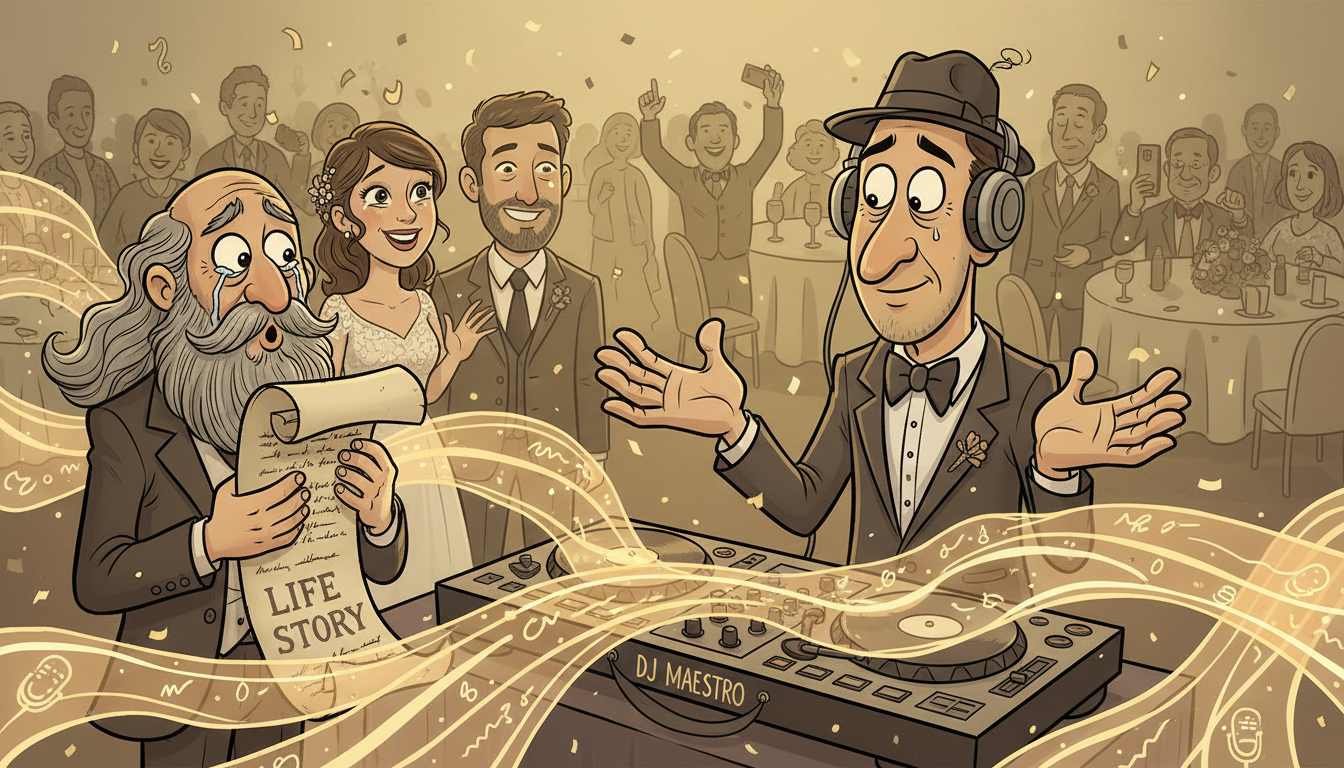
She was DJing a wedding. The officiant was the groom's father. Before the ceremony, he kept approaching her. Nervous. Needing to go over his script. Precious's instinct wasn't to brush him off. She put everything down and gave him her full attention.
The ceremony was beautiful.
Then at dinner, a woman approached Precious. Teary-eyed. She held Precious's hand and said: "I want to thank you so much for what you did for my husband."
She explained that the officiant was her husband. And that they had lost their youngest son three months before the wedding. Writing that ceremony script was what had helped him keep moving through his grief.
Precious had made him feel seen.
And when Precious told me this story on camera, she said something I've thought about almost every day since.
"I thought, well, it's a part of my job. I didn't think it was anything different. But it was different for her."
That single line is the entire thesis of brand storytelling.
DJ Maestro wasn't selling music. They weren't selling equipment or song libraries or "the best DJs in town." They were selling the experience of being seen on the most important day of someone's life.
They just didn't know how to say it.
After the brand story film launched, Tony's response said it all: "We now have a powerful tool that not only connects with our audience but also finally articulates who we are as a company in a real and authentic way."
That's the dopamine payoff. Years of frustration. Resolved. And it happened because we excavated the real story instead of polishing the brochure.
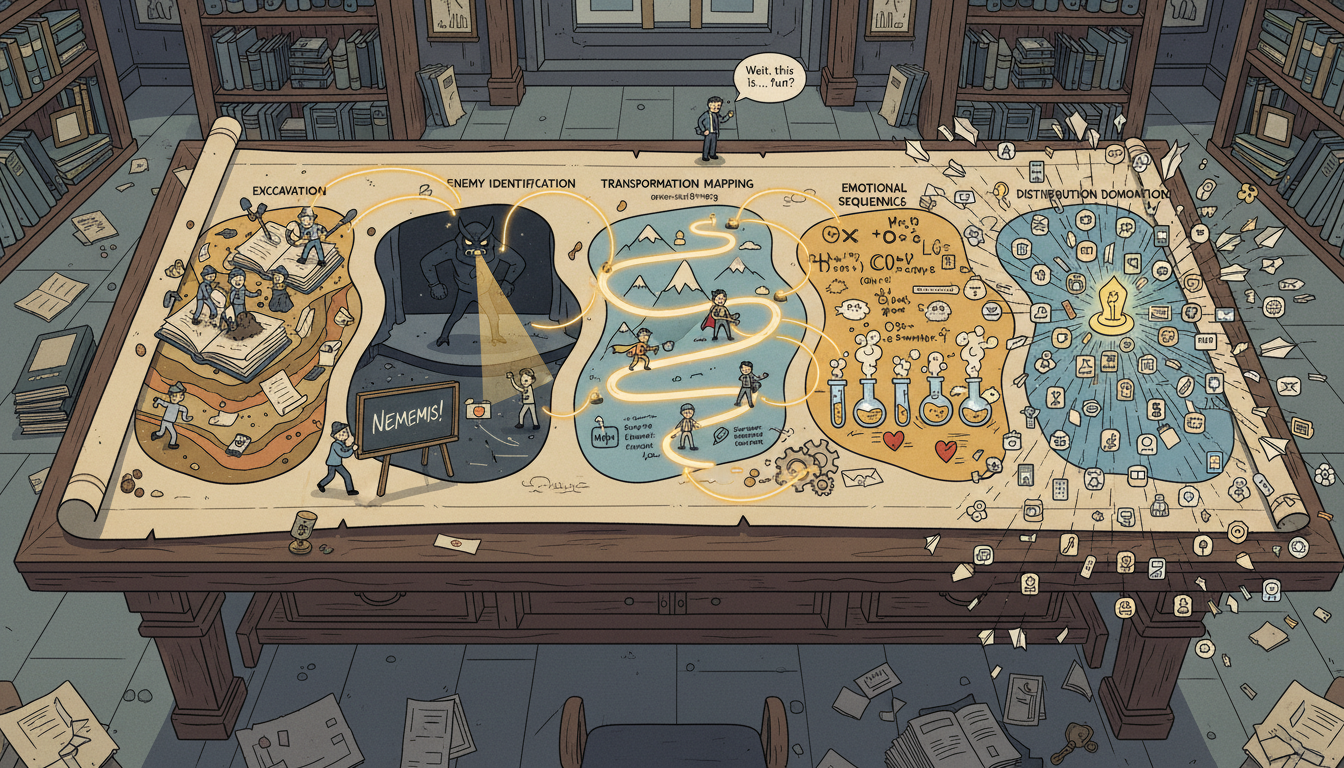
The Story Architecture System
Every brand has a story. The problem is never that a story doesn't exist. It's that there's no architecture.
Raw story material without structure is noise. Structure without authentic material is formula. You need both.
Phase 1: Story Excavation™
You can't tell a story you haven't found. This phase is about interviews with founders, customers, and team members. Not the polished boardroom version. The real story. The Precious moments. The ones that make people cry on camera because they forgot those moments mattered.
Phase 2: Enemy Identification™
Every brand story needs a villain. Not a person. A force. For DJ Maestro, the enemy was the belief that a DJ "just plays music." For a SaaS company, it might be manual processes. For a services firm, the commoditization of expertise.
Name the enemy. It creates the tension cortisol demands. Without it, your story has no stakes.
Phase 3: Transformation Mapping™
Chart the hero's journey. And the hero is always the customer. Never the brand.
What's their "before" state? Frustrated. Stuck. Invisible. What's the trigger that makes them realize something has to change? How does your brand guide them? And what does the "after" look like? Confident. Clear. Uncopyable.
Phase 4: Emotional Sequencing™
This is the neurochemical formula applied. Tension first. Then a character to care about. Then resolution.
Every piece of content follows this sequence. A 7-minute brand film and a 15-second social clip. The format changes. The chemistry doesn't.
Phase 5: Distribution Domination™
A brand story on one page is wasted. This phase puts the story everywhere buyers are. Website. LinkedIn. YouTube. Email sequences. Sales conversations.
One hero story becomes 40+ derivative pieces. The story becomes the system.
The difference between this and a generic framework? Every phase maps to a neurochemical trigger. Every phase produces a real deliverable. Not a slide deck. Not a "brand book" that sits in a drawer.
Brand Storytelling for B2B
There's a myth that brand storytelling is for consumer brands. The Nikes and Apples. B2B? That's for whitepapers.
This is backwards.
B2B decisions involve higher stakes. Longer sales cycles. More decision-makers. The emotional weight of a B2B purchase is often greater than a consumer one. "Will this make me look smart or get me fired?"
That's why storytelling for B2B and SaaS companies isn't optional. It shortens sales cycles. It pre-qualifies leads. And it gives your internal champion the language to sell on your behalf.
Picture a VP of Marketing watching a brand story that nails their exact pain. They forward it to their CMO with the note "this is us." That's not content marketing. That's sales enablement powered by narrative.
And the same applies to small businesses. A local company with an authentic story will outperform a competitor with a bigger budget and generic messaging. Every time. Authenticity is the one thing money can't buy and AI can't fake.
The $100K Lesson
Here's a story I don't usually share.
Early in my career, I worked for a video production company. A client paid $100,000 for a series of 30-second commercials and some training content. Two-day shoot. Significant post-production. I did the post work as a full-time employee making less in a year than that single project cost.
The budget wasn't unreasonable. But here's what got me.
That $100,000 went to production value. Equipment. Crew. Polish. Very little went to narrative strategy.
The content looked professional. Technically excellent. But forgettable. Because the story hadn't been built. No enemy. No arc. No emotional sequence. Just well-lit feature-dumping.
I would gladly work in a six-month brand partnership for that same amount. Providing the strategy, the excavation, the emotional architecture, AND the production. The gap in results would be staggering.
Not because the production value would be less. But because the narrative value would be on a completely different level.
And that's the structural problem. Brands overspend on production and underinvest in story. They hire cinematographers when they need architects. They buy cameras when they need clarity.
The Holonarchy of Brand
There's a concept from systems theory that I've been applying to storytelling. The holonarchy.
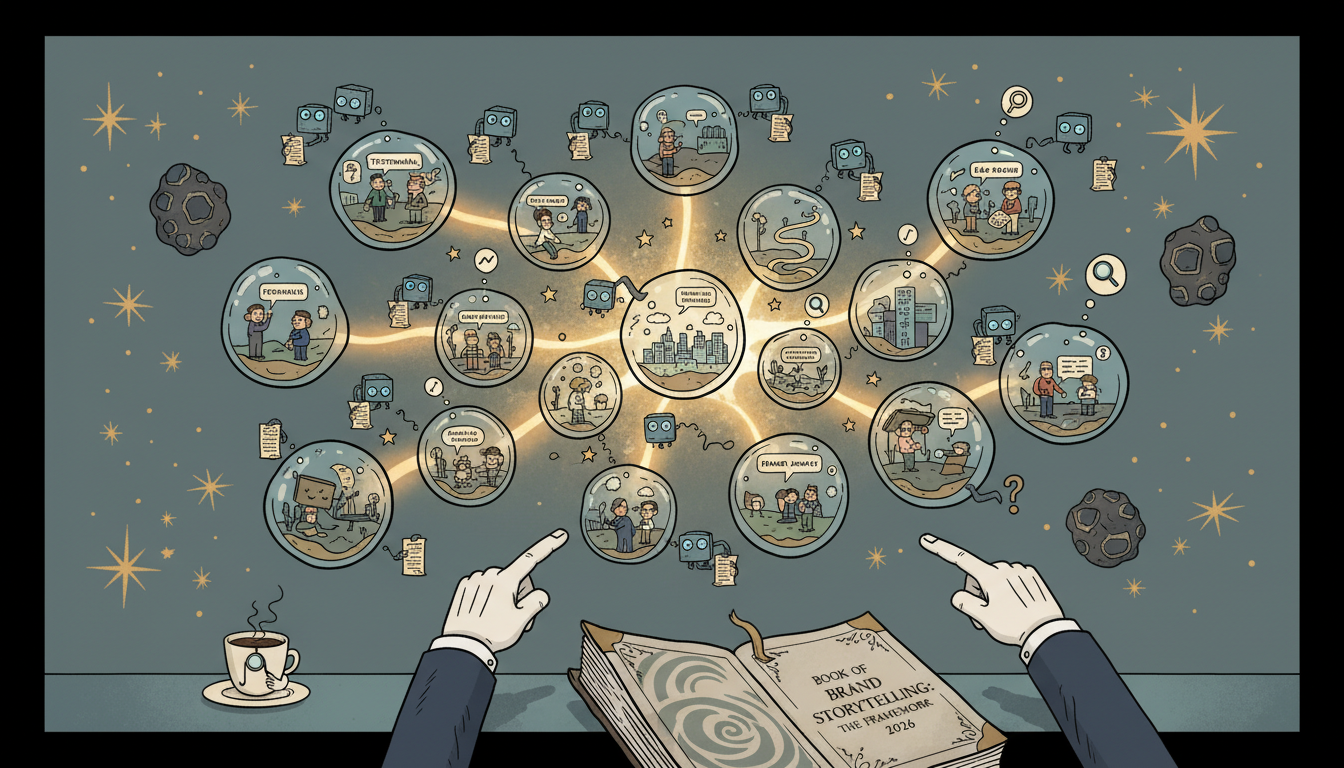
A holon is a self-contained whole that's also part of a larger network.
Think of it like this. A single customer testimonial is complete on its own. It has a beginning, a conflict, a resolution. But it's also part of a larger case study. Which is part of a larger brand narrative. Which is part of a larger market conversation.
Each piece of content you create should work as a holon. Complete by itself. More powerful when connected to everything else.
This is also how AI search works in 2026. ChatGPT, Perplexity, and Google's AI Overviews don't rank pages. They extract passages. Each self-contained answer within your content is a holon that gets cited across dozens of different search queries.
More holons in your content. More surfaces for AI citation.
The brands that understand this will dominate. Not by gaming keywords. But by creating content so genuinely human and so architecturally sound that AI has no choice but to cite it.
What Makes a Good Brand Story
After hundreds of brand stories, the pattern is clear. Five elements show up every time.
1. A human at the center. Not a product. Not a logo. A person with stakes and fears. Oxytocin requires a human subject. No character, no empathy. No empathy, no trust.
2. A named enemy. Tension requires opposition. The enemy doesn't have to be a competitor. It can be a status quo. A misconception. A systemic failure. But it has to be specific enough that your audience recognizes it instantly.
3. A before-and-after arc. Before state. Trigger. Journey. After state. This is the structure that maps to the neurochemical formula. Skip any part and the story falls flat.
4. Specificity over generality. "We increased conversion by 25%" beats "we improve results." "Three months after losing their son" beats "during a difficult time." Specific details activate mirror neurons. Generalities activate nothing.
5. An authentic voice. Not polished corporate speak. Not AI-generated filler. The human perspective, with all its imperfections and unexpected connections, is the moat. It's the thing nobody can replicate by pressing a button.
Building Your Brand Story
If you've read this far, you're already ahead of 90% of brands still feature-dumping. Here's how to start.
Step 1: Audit your story gap. Look at your messaging. Swap your company name with a competitor's. If it still works, you have a gap. Score yourself on the five dimensions.
Step 2: Excavate before you create. Before you hire a videographer or write a word of copy, do the interviews. Talk to your founder. Talk to your customers. Talk to your team. Record everything. The real story will surface in the conversations you least expect.
Step 3: Name your enemy. What force does your brand defeat? What status quo do you disrupt? Name it out loud. Your audience is living in that world right now. They need to hear you say what they're feeling.
Step 4: Map the change. Where are your customers before they work with you? Where are they after? Chart it in specific, emotional terms. This becomes the backbone of everything you create.
Step 5: Build the emotional arc. Then distribute everywhere. Tension. Empathy. Resolution. Apply that sequence to every format. Then put the story everywhere your buyers are. One story. Forty-plus surfaces. Consistency builds the brand.
Features to Feelings
In 2026, AI generates content at scale. It summarizes. It synthesizes. It simulates voice.
What it can't do is experience.
The grief of a father writing a wedding ceremony script three months after losing his son. The instinct of a DJ who put everything down to simply be present. The moment a founder scrolls past a carousel and realizes everything needs to change.
Those moments are imperfect. Unrepeatable. Deeply human. And they're the raw material that makes brand storytelling irreplaceable.
Real storytelling has the power to evoke emotion, inspire thought, and create change in the world. Getting clarity on your brand story is the exercise that pushes everything else forward.
It's time to go from features to feelings.
Features to feelings. Feelings to behavior. Behavior to profit.
That's not a tagline. It's a neurochemical fact. And it's the foundation of every brand that has ever moved from invisible commodity to uncopyable category leader.
The story is already inside your brand. You just need someone to help you find it.
George V.K. is the founder of TRUERY and creator of the Story Architecture System™. Take the free Story Gap Quiz to find where your brand's story is leaking leads.